
The second quarter of 2026 was marked by significant geopolitical tensions, particularly surrounding the conflict between the United States and Iran. After a period of uncertainty and temporary ceasefires, a provisional agreement was finally reached to end the war and reopen the strategically important Strait of Hormuz. These developments caused sharp fluctuations in the markets: the price of oil fell sharply following the agreement, after which inflationary pressures also eased slightly. Nevertheless, the situation remained fragile; a lasting and stable solution still seems a long way off, leaving markets vulnerable to news from the Middle East.
The economic impact of geopolitical tensions was evident in a renewed rise in inflation, driven primarily by persistently high energy prices. Inflation continued to rise in both Europe and the U.S., forcing central banks to tighten monetary policy once again. The European Central Bank (ECB) and the U.S. Federal Reserve raised interest rates to keep inflation in check. This occurred despite slowing economic growth, particularly in Europe, where consumers and industry became more cautious due to lower purchasing power and increasing uncertainty.
Despite the turbulent news, investors focused primarily on the strong performance of technology and AI-related companies, which drove global stock indices to record levels. SpaceX’s initial public offering also attracted a lot of attention.
DC Fund Investments
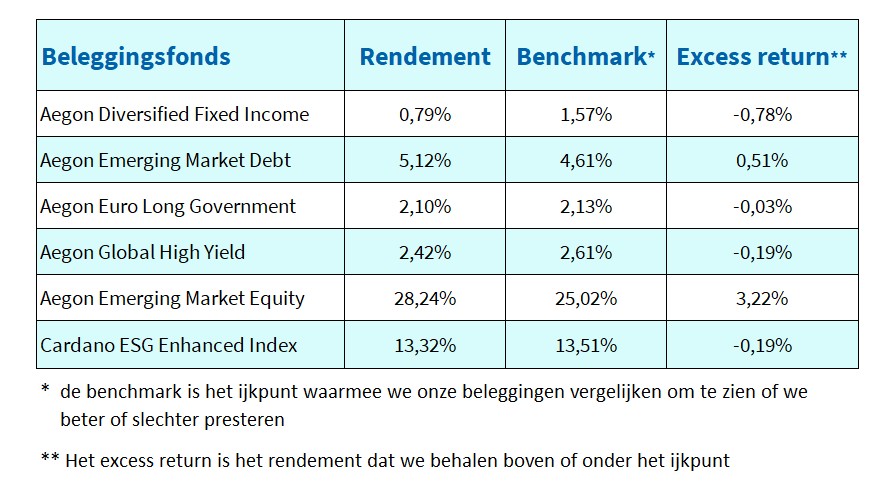
Aegon Diversified Fixed Income
This mixed fund (government bonds (10%), corporate bonds excluding financials (40%), and Dutch residential mortgages (50%)) posted a positive return in the second quarter of this year, but underperformed the benchmark on a relative basis. This was due to the performance of Dutch residential mortgages. Market rates for these remained stable, while yields on government bonds—which serve as the benchmark—actually declined. With stable unemployment figures, rising home prices, and low delinquency rates, the mortgage market remains in good shape.
Aegon Emerging Market Debt
The strong return in the second quarter was primarily due to the lower risk premium for EMD. The higher risk profile (in terms of credit quality, compared to the benchmark) also generated additional returns. In particular, investments in Argentina, South Africa, and Brazil made a positive contribution to the result, while limited or no investment in countries with high creditworthiness but low credit spreads—such as Malaysia, Uruguay, and the Philippines—also had a positive effect.
Aegon Euro Long Government
In the second quarter of 2026, the fund achieved a positive absolute return of 2.10%. This result was primarily driven by falling interest rates on European government bonds. However, at -0.03%, the return lagged slightly behind the benchmark, primarily due to differences in valuation methods and transaction costs incurred to keep the portfolio in line with the benchmark. The benchmark’s yield stood at 3.3% at the end of the quarter.
Aegon Global High Yield
This fund’s positive absolute return was primarily due to the decline in risk premiums in the global high-yield market and the favorable market environment for corporate bonds with lower credit ratings. Nevertheless, the relative return compared to the benchmark lagged somewhat because the fund managers maintained a defensive portfolio with lower risk, which meant they benefited less from the strong market conditions. In particular, the selection of bonds within the energy and other financial sectors had a negative impact on relative performance, while differences in regional allocation and sector weightings remained relatively limited.
Aegon Emerging Market Equity
Emerging market stocks posted spectacular returns in the second quarter of 2026. This was primarily due to positive sentiment surrounding the technology sector (which posted a return of no less than 74.6% in Q2), particularly among companies benefiting from global demand for AI-related semiconductors in Korea and Taiwan. The fund outperformed the benchmark by a significant margin (3.2%). This strong result was primarily due to successful stock selection in the technology sector and among AI-related companies. At the same time, the underweight position in the energy sector, which declined in value, also contributed positively.
Cardano ESG Enhanced Index
Equities in developed markets also had a very strong second quarter, with the benchmark posting a 13.5% return. Here, too, there was enthusiasm surrounding AI and technology. Underlying this, we saw companies report strong financial results. Partly as a result, indices reached (new) all-time highs. The Cardano fund lagged slightly behind the benchmark. The underweight positions in the communications and energy sectors worked in its favor; however, the exclusions in the information technology and healthcare sectors had a slightly greater negative impact over the past quarter.