
The third quarter was marked by geopolitical tensions and political instability. Initially, President Trump continued his policy through instruments such as the “One Big Beautiful Bill” and “retaliatory tax. In doing so, he announced (additional) levies for various countries and sectors. Bilateral trade deals later calmed tempers somewhat.
The US central bank was also under fire. Trump wants lower interest rates to stimulate the economy, but Fed Chairman Powell stands firm and is guided only by economic indicators. To put pressure on the Fed, this time Trump aimed his arrows at Fed director Lisa Cook, whom he accused of mortgage fraud and demanded her resignation.
On the economic front, we saw that the non-farm pay rolls (the U.S. labor market report) were disappointing which could mean a cooling of the economy. Later in the quarter, the Fed did cut interest rates by 0.25%. The market noted from the Fed meeting minutes that more interest rate cuts may be expected.
In Europe, the ECB maintained interest rates at 2%, which was as expected. France made negative headlines due to yet another fallen government. As a result, the interest rate differential between French government bonds on the one hand and Dutch or German government bonds on the other increased further.
Financial markets were positive last quarter, noting that within the commodity category gold rose sharply in price. The euro fell very slightly versus the U.S. dollar, trading just above 1.17 at the end of the quarter. The Japanese yen lost further against the euro again at 173.5.
DC Fund Investments
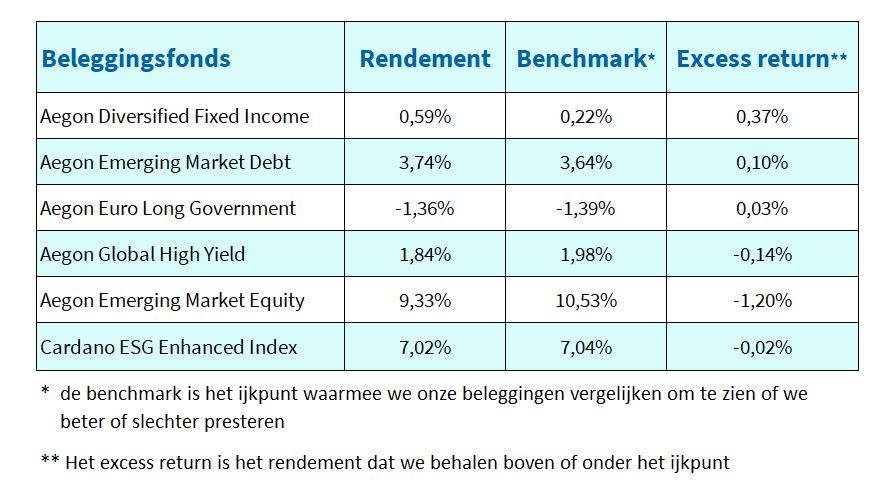
Aegon Diversified Fixed Income
Like last quarter, all excess return of this mix fund (government bonds (10%), corporate bonds excluding financials (40%), and Dutch residential mortgages (50%)) came from the mortgage category. Dutch government interest rates rose in the third quarter. The relatively higher return was achieved because mortgage interest rates, however, rose just slightly less than the Dutch government interest rate (which acts as a benchmark). At the mortgage fund, the valuation method was adjusted. In particular, removing the offering risk from the discount rate had a positive effect on the value of the fund.
Aegon Emerging Market Debt (EMD)
For EMD, on the contrary, there was a slightly lower benchmark interest rate at the end of the third quarter. On top of this, the risk premium of EMD over government bonds continued to decline by 0.30% to 2.16%. The fund did relatively better than the benchmark because it invests slightly riskier than the benchmark. The fund invests in two underlying managers, combined positions in Ivory Coast were the most lucrative last quarter.
Aegon Euro Long Government
The fund is a passive mutual fund that aims to approximate benchmark returns. European government bonds achieved negative returns in the third quarter as interest rates rose for all maturities. The increase was slightly stronger than average for longer maturities. For example, 10-year Dutch government bond yields rose 0.06% (from 2.81% to 2.87%), while 30-year Dutch government bond yields rose 0.22% (from 3.22% to 3.44%). The interest rate differential between the Netherlands and Germany for both 10-year and 30-year rates is around 0.17% (NL rates are higher).
Aegon Global High Yield
Due to higher risk appetite among investors, the Global High Yield market also experienced positive returns in the third quarter. The risk premium fell further to 2.88% relative to government bonds, down 0.25% from the second quarter. The benchmark return was 1.4% higher than a portfolio of government bonds with the same maturity profile. In terms of regions, the differences were small. In terms of sectors, the energy sector stood out positively. Since the fund is underweight relative to the benchmark, it lagged slightly behind in relative terms.
Aegon Emerging Market Equity
Emerging market equities performed very strongly in the third quarter (+10.5% for the benchmark). The biggest drivers were reduced political tension between the U.S. and China, and strong growth in AI and related technologies (especially the chip sector). Although the Asia region (+10.8%) had the highest returns, there was also a dissonance within that region. India (-7.7%) faced an increase in export tariffs by the US. The fund lagged the benchmark by 1.20% in the third quarter. This was mainly due to the underweighting of the commodities sector, which was the best performing sector by as much as 23.8%. The underweighting of China (which posted a 20.6% return) also contributed negatively to the relative performance against the benchmark.
Cardano ESG Enhanced Index
Equities developed markets also had a fine third quarter with a 7.0% return. The U.S. and Japan led the way with about +8% and Europe lagged behind with a plus of 3.5%. IT was the best performing sector. The fund’s return was almost equal to the benchmark. Relative to the benchmark, the largest positive contribution came from stock selection within the energy sector (+0.35%), and the largest negative contribution came from stock selection within the industrial sector (-0.19%).